The Unique Design of Grand-Mère Ovens
The exceptional thermal inertia of our ovens is due in large part to their highly ingenious design, which was carefully developed 45 years ago. Drawing on scientific studies and the performance of modern insulation materials, Jean-Luc Tisserant and François Georges reinvented wood-fired ovens for bakers by optimizing all the key parameters.
The shape and height of the vault
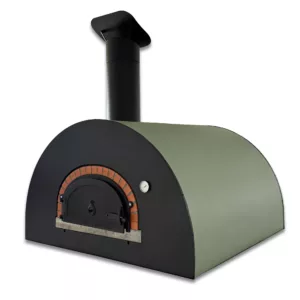
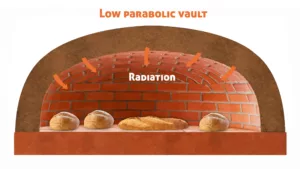
The vault of our ovens is parabolic in shape and intentionally very low, only 25 to 27 cm high. This allows it to be easily heated by the flames and to transmit heat much more effectively to the baking stone and the loaves than a taller vault would.
In fact, it takes very little energy to heat the floor and vault, which reach high temperatures very quickly.
Modern, high-performance insulation materials
For centuries, a considerable mass of sand, brick, or silt was needed to prevent heat from escaping outward. Thanks to the advent of more modern insulation materials, the mass of a baker’s oven is no longer a determining factor, because if the insulation is excellent, almost no heat escapes.
Three types of insulation allow us to retain heat extremely well, as close as possible to the area where it’s needed—that is, within the very first few centimeters of the floor and vault:
- High-temperature mineral wool. To insulate the vault, we use a flexible layer of mineral wool, a material with a thermal conductivity of 0.09 W/m·K at 400 °C.
- Vermiculite mortar, used as a base insulation. It is a mixture of fused cement and beads of perlite and vermiculite, a natural mineral in the mica family. The thermal conductivity of this material is 0.15 W/m·K at 400 °C.
- For our rotary ovens, an additional layer of calcium silicate is applied beneath the entire oven. This chalky material has a thermal conductivity of 0.10 W/m·K at 400 °C.
In terms of thermal performance, mineral fiber insulation is 10 times more effective than fireclay and even 60 times more effective than sand.
Our goal: to generate and retain only useful heat
In heavier floor ovens, the substantial mass absorbs more heat, and the heat is “lost” as it diffuses throughout the entire thickness of the oven. However, this heat that diffuses into the mass too far from the cooking zone is wasted:
- They rise or fall only very slowly or not at all toward the baking room, because, by definition, heat conduction is slow in a refractory material. Selected for its high thermal inertia, a refractory material cannot ensure rapid and uniform heat transfer throughout its mass, especially if that mass is large.
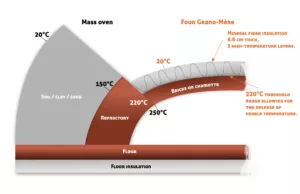
- In a thick structure, the temperature in areas far from the baking room is simply too low to be useful. According to tests and measurements conducted by the founders of Four Grand-Mère, only the heat transfer from the first 5 to 6 centimeters of the refractory material is truly usable during consecutive baking cycles. In practice, this means that only the heat from these first few centimeters around the baking chamber is useful and not much more because it is this heat that warms the top 2 centimeters, which cool down upon contact with the dough and during baking.
It is therefore these first few centimeters that must be thoroughly heated and kept at the proper temperature. A thickness of 6 to 8 cm for both the base and the vault is optimal and more than sufficient.
Extremely lightweight for remarkable performance
Because Grand-Mère ovens provide excellent heat distribution thanks to their low vault, and because modern insulation keeps the usable heat trapped as close as possible to the baking room, our bakery ovens are much lighter than those of our competitors, while delivering equivalent or even superior performance.
For example, while some of our competitors believe it is necessary to build a floor slab more than 30 cm thick with a vault approximately 20 cm thick, spaced more than 40 cm apart, Four Grand-Mère achieves at least equivalent performance with a 6- to 8-cm-thick floor and an 8-cm-thick vault!
In simple terms, Grand-Mère ovens work much like a thermos—they’re very lightweight but retain heat very well, thanks to a sort of double wall:
- The floor and vault, made of brick or chamotte refractory material and positioned close to each other, which absorb and retain heat.
- Modern high-performance insulation materials, which trap it as close as possible to the cooking chamber.
Energy-efficient and easy-to-use wood-burning ovens
Thanks to this unique and ingenious manufacturing technique, Grand-Mère bakery ovens are 2 to 3 times lighter than those of our competitors, with an average floor load ranging from 500 to 650 kg/m² depending on the model.
The Advantages of a Non-Masonry Bakery Oven During Installation
Right from the installation stage, our ovens stand out for their convenience, as they are:
- Quick and easy to install. In most cases, you won’t need to reinforce the bakery floor slab. If this is your first time installing a Grand-Mère oven, three people working for three to four days will be enough to complete the entire installation.
- Quick to set up. The drying time is very short.
- Can be disassembled if necessary. Since no parts are set in mortar, the oven can be completely disassembled… and easily reassembled in another bakery.
Ways to Save Wood in Your Daily Life
Because the mass of our ovens is highly optimized, they heat up faster and maintain a nearly uniform temperature throughout their depth while requiring very little energy.
Expect a very short heating time of about 2 hours and 30 minutes for the first heating of the morning, as the vault and floor heat up quickly, while the heat remains trapped in the baking chamber and the refractory lining, as close as possible to the baking zone for bread, brioches, and more…
Based on our own measurements and feedback from our customers, our wood-fired ovens for bakers lose only 5 to 7 °C per hour. The usable heat, which is fully utilized for baking, remains available for several batches without the need for reheating.
For example, one of our customers who owns a 2803 FL a side-fired oven with a lateral throat bakes four batches of about 100 500-gram loaves on a single heat cycle, followed by a brief reheating period (15 minutes of heating and 15 minutes of rest) before baking additional batches.
This clearly shows that you can bake just as many consecutive batches in a very lightweight Grand-Mère oven as you can in a traditional masonry wood-fired oven. In practical terms, you handle and use much less wood on a daily basis, while enjoying an oven that’s much more responsive and easier to use !
François Célérier, CEO of Four Grand-Mère.